
NeuroCinema
Role: BCI Researcher & TouchDesigner Prototype Developer
Working with Dr. Graham Sack, I built the working prototype behind NeuroCinema, a system in which a viewer’s live brain activity influences which scenes appear and how quickly the film is edited. Giorgios Cherouvim later reworked and expanded the prototype into the final installation presented at the 2025 Tribeca Film Festival.
Project Details
- Project Type: Brain-computer interface research and interactive media prototyping
- Institution: Johns Hopkins Berman Institute of Bioethics and Johns Hopkins Applied Physics Lab
- Context: Independent Study with Dr. Griffin Milsap
- Tools: G.tec Unicorn EEG, TouchDesigner, OSC, browser-based EEG decoder
- Outcome:Foundational prototype contributing to an immersive installation presented at the 2025 Tribeca Film Festival
The interaction concept
NeuroCinema explores what happens when a viewer’s own brain activity becomes part of the editing process. A participant wears an EEG headset. Neural signals influence both the scene that appears and the pace of the edit, so each participant experiences a different version of the same visual material.
The goal was not to visualize brain data for its own sake, but to create an interaction audiences could perceive and understand.
My contribution
My work began during an Independent Study with Dr. Griffin Milsap, a biomedical engineer at the Johns Hopkins Applied Physics Laboratory.
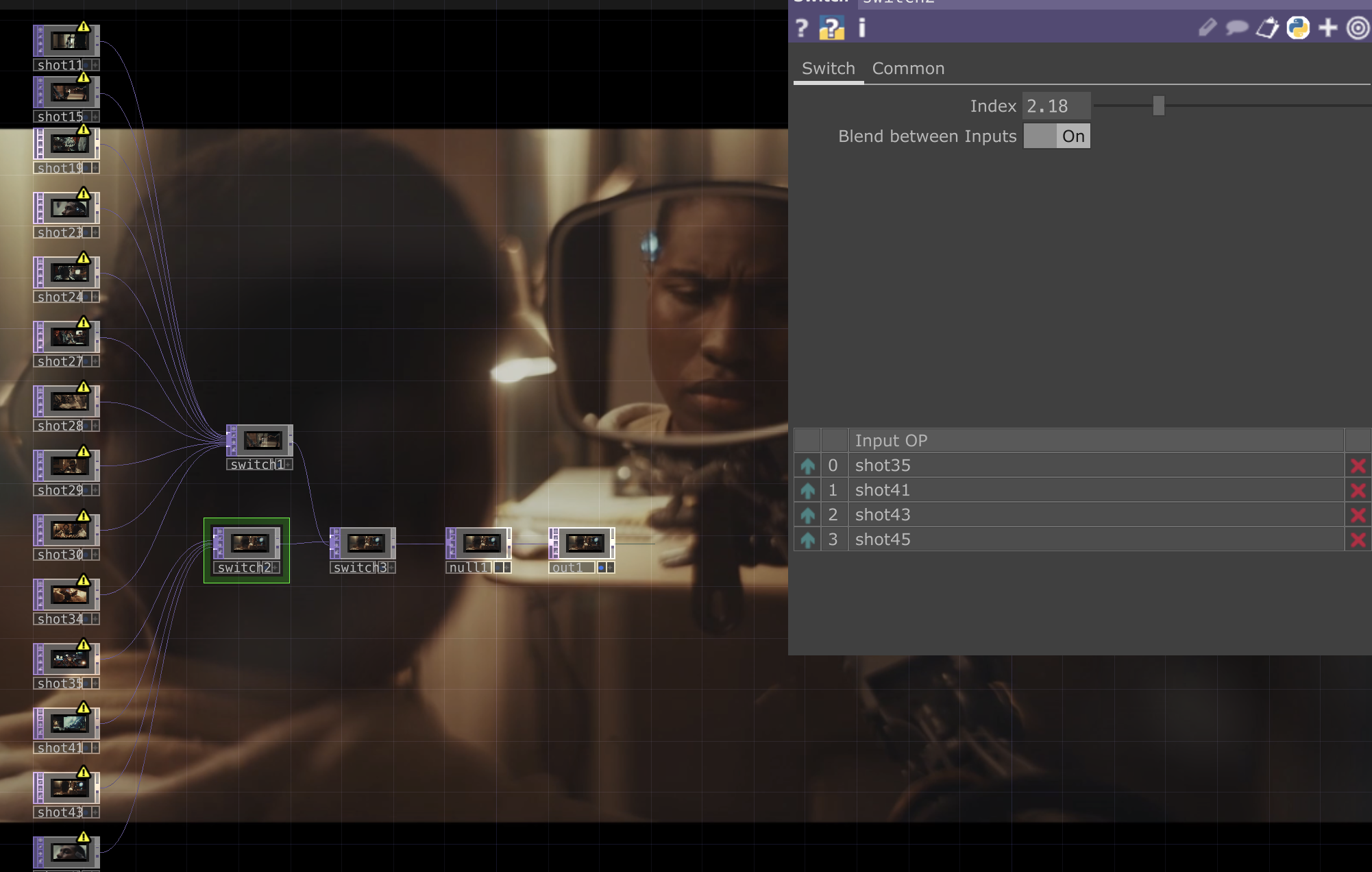
I assembled the G.tec Unicorn EEG hardware, connected processed neural data to TouchDesigner through OSC, and built a node-based prototype that translated physiological signals into video-editing decisions. The prototype established a foundational BCI-to-video workflow that informed later development.
Interaction design
The system explored two forms of agency. Participants selected among three projected scenes using SSVEP-based input. By focusing on a flickering visual target, the viewer could intentionally choose which scene appeared.
Early tests with subtle visual modulation proved unreliable once light from multiple projections mixed in the room. We switched to high-contrast checkerboard grids, which produced more dependable selection.
Once a scene was chosen, broader brainwave activity influenced editing speed. Higher alpha activity slowed the edit, while beta and gamma increased its pace. The result combined deliberate control with involuntary influence.
Designing audience agency
The participant neither fully controlled the film nor simply watched it. Scene selection was intentional. Edit pacing responded to broader changes in neural activity.
To make that relationship legible, I used thresholds and smoothing to translate noisy, continuous physiological signals into stable editing decisions. That design process reinforced an important principle: an interactive system is only meaningful if the audience can understand the relationship between their actions and what changes.
From prototype to installation
The foundational prototype contributed to an immersive installation presented at the 2025 Tribeca Film Festival. Each stage built on a distinct contribution.
Research & decoding
Dr. Griffin Milsap supervised the research and provided the decoding framework.
Working prototype
I built the working TouchDesigner prototype that established the interaction model.
Final installation
TouchDesigner artist Giorgios Cherouvim later reworked and expanded the prototype for the final installation.
Film connection
The installation connected to NeuroPlastic, Dr. Sack’s short film about BCI-assisted rehabilitation, presented at Tribeca in 2025.
What the project
taught me
NeuroCinema changed how I think about interactivity. The most meaningful system is not necessarily the one that captures the most data. It is the one that creates a relationship an audience can understand. The project also taught me to design real-time systems around uncertainty rather than against it.
Those lessons, especially the need to normalize noisy signals, build around failure, and make interaction legible, directly informed my later work on hyper_object.
Beyond
the screen
The system also extended into physical interaction. Jaw-clench EMG signals and head-orientation IMU data were translated into predefined movements of a robotic arm, creating a second, embodied channel of interaction alongside the projected film.
The project therefore moved beyond brain-driven editing toward a broader investigation of how biological signals could influence audiovisual and physical environments.
Next project: Valve House Chronotope
Explore the next featured project.