
Valve House Chronotope
Role: Researcher, Immersive Media Designer, Filmmaker & 3D Reconstruction Artist
Valve House Chronotope is a work-in-progress digital reconstruction of a historic Baltimore waterworks building, designed to let audiences move among its past, present, and possible future. I have researched and documented the site, captured it through LiDAR and photogrammetry, rebuilt damaged geometry in Blender, and produced a proof-of-concept video. Early development has also begun in Unreal Engine.
Project Details
- Project Type: Independent immersive storytelling and digital heritage project
- Location: Clifton Park, Baltimore, Maryland
- Tools: Polycam, LiDAR scanning, photogrammetry, Blender, Unreal Engine, digital camera
- Status: Proof of concept completed; interactive reconstruction in early development
Why the Valve House
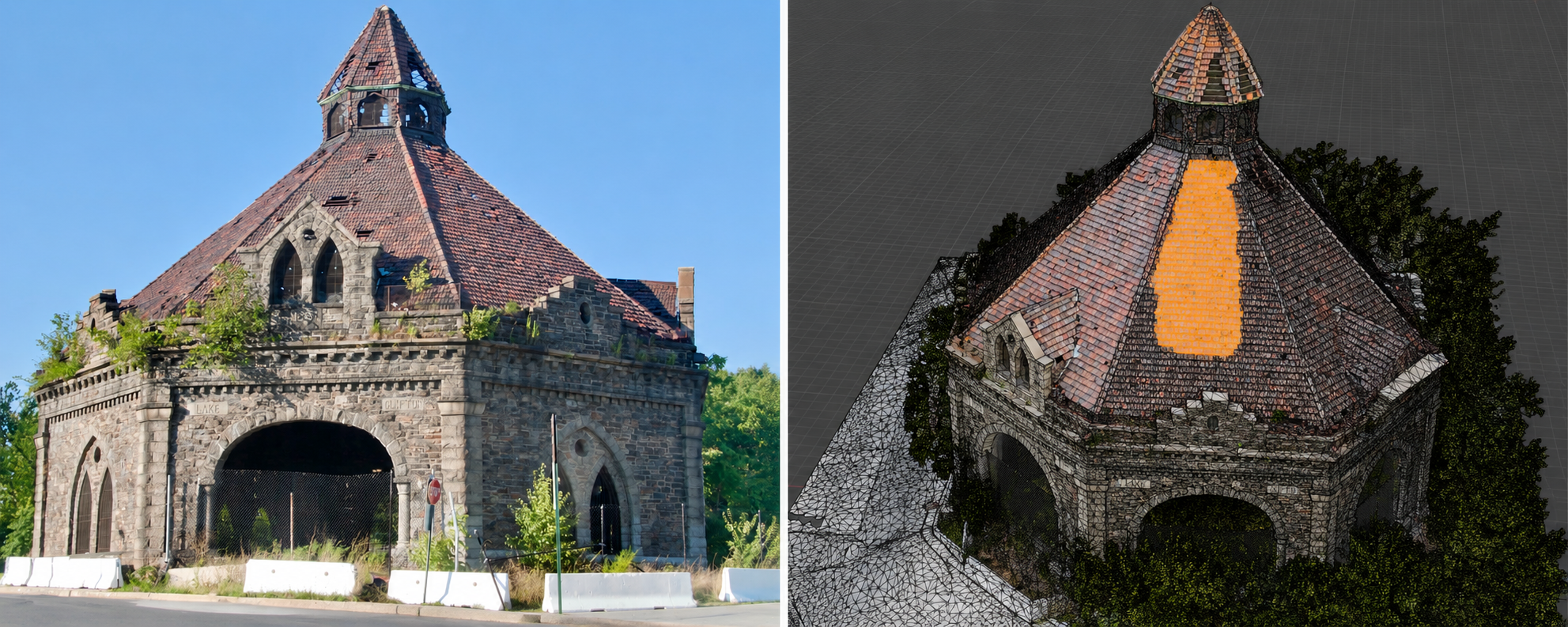
I first encountered the Valve House while passing through Clifton Park in Baltimore. From the road, it appeared less like municipal infrastructure than a ruined civic monument: a dark stone octagon with Gothic windows, fragments of stained glass, a terra-cotta roof, and a central tower rising through vines and chain-link fencing.
Research revealed a building that once played an important role in Baltimore’s municipal water system. That discovery became the starting point for the project.
The project
Valve House Chronotope asks how architecture can tell a story across time. The long-term concept is an interactive reconstruction in which audiences can move among three states of the same structure:
- Its period as functioning civic infrastructure
- The present-day ruin
- A speculative future in which the building serves the city again
The project combines historical research with immersive media to explore not only what the structure looked like, but what its changing condition says about public infrastructure, civic memory, and reuse.
Scanning a ruin
I captured the exterior using LiDAR and photogrammetry through Polycam. The site resisted clean reconstruction. Two layers of fencing and dense vegetation had become entangled with the architecture in the scans, producing scan geometry too noisy to use directly. Stone, vines, fencing, broken glass, and missing surfaces often collapsed into the same mesh.
A ruin is a difficult scanning subject precisely because the evidence of time has physically fused with the structure. That challenge became part of the project rather than simply an obstacle to remove.
Rebuilding in Blender
I brought the scan into Blender and began by reducing the polygon count so the model could be edited efficiently. I then separated the geometry into recognizable architectural components and began reconstructing damaged or obscured sections.
Surviving architectural evidence provided the basis for rebuilding missing areas. Intact roof-tile geometry, for example, could be duplicated and adapted to reconstruct sections that had been lost. Virtual cameras also made it possible to create tracking shots that could not be captured physically because of access limitations at the site.
Those sequences were combined with location footage and an original teaser script to create the rough cut of a proof-of-concept video.
Moving into real time
Early work has also begun in Unreal Engine. The goal is to move beyond a static reconstruction and create an environment that audiences can explore. Rather than presenting one definitive version of the building, the interactive experience would allow visitors to move among different historical states and understand how the site has changed.
Why “Chronotope”
“Chronotope” describes the relationship between time and space within a narrative. Here, one structure becomes an entry point into several moments in Baltimore’s history. The project imagines a restored past, a present-day ruin whose damage remains visible rather than erased, and possible futures connected to public interpretation, water, and climate resilience. The aim is not simply to recreate a lost building. It is to make the building’s changing relationship to the city visible.
What restoration
taught me
Digital restoration is not only about reproducing what a structure once looked like. It is also about restoring context. The damage, vegetation, fencing, and noise captured in the scans are not merely technical problems. They are evidence of the building’s present condition and its relationship to the city around it.
The challenge is therefore not to erase the ruin in pursuit of a perfect model. It is to decide what should be reconstructed, what should remain visible, and how those different layers of time can coexist within one experience.
Explore more featured projects
Discover more work in storytelling, interactive media, and emerging technology.