
hyper_object:
The Age of Cruel Miracles
Role: AI Systems Designer & Production Associate
A case study in EEG-driven AI dialogue design
Working with writer and director Dr. Graham Sack, I designed and built the eva_rewriter, an EEG-driven system that let one actor’s live brainwave measurements shape another character’s dialogue in hyper_object, a neurotheater adaptation of Solaris performed for more than 200 people. The project began not with code but with a comparative analysis of seven Solaris adaptations.
Project Details
- Project: hyper_object: The Age of Cruel Miracles — Neurotheater, Johns Hopkins University
- Director: Dr. Graham Sack, Berman Institute of Bioethics, Johns Hopkins
- UniversityFunding: Johns Hopkins Nexus Research Award; Dracopoulos-Bloomberg iDeas Lab
- Premiere: June 4, 2026 — Hopkins Bloomberg Center, Washington, D.C. — 200+ attendees
The dramatic problem
hyper_object: The Age of Cruel Miracles is a live neurotheater production written and directed by Dr. Graham Sack, adapting Stanislaw Lem’s Solaris for the era of AI and wearable neurotechnology.
In the production, the character Eva appears not as an autonomous person but as an unstable projection of her partner Kantor’s mind. Staging that premise live required a system that could make the relationship tangible in real time. I designed and built that system: the eva_rewriter.
Research before code
I conducted a comparative analysis of seven Solaris adaptations spanning seventy years, including Lem’s novel, two film scripts, a radio adaptation, and an opera libretto. I traced how the wife/visitor character’s language shifts across versions, looking at vocabulary, syntax, emotional register, uncertainty, and patterns of self-interruption. That research produced five linguistic parameters:
- Coherence
- Emotional intensity
- Certainty
- Abstraction
- Vocabulary richness
Those parameters became the operating logic of the system.
System architecture
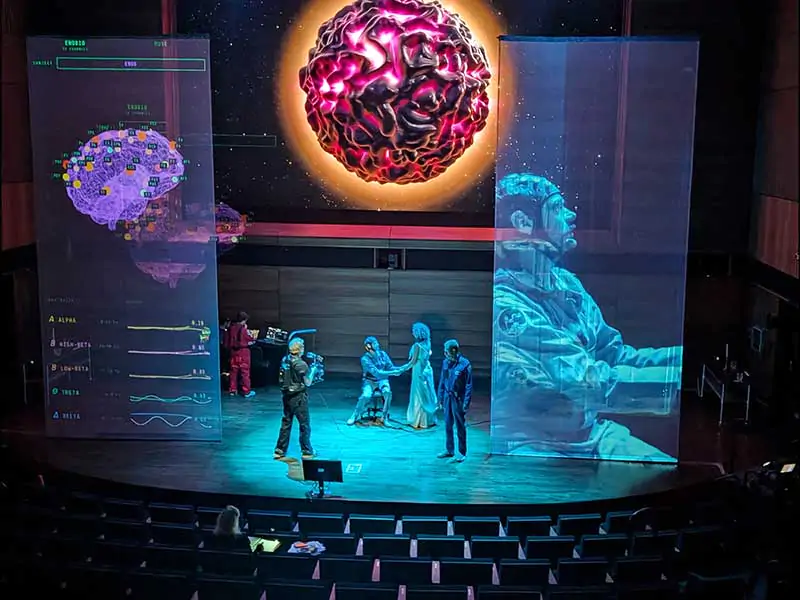
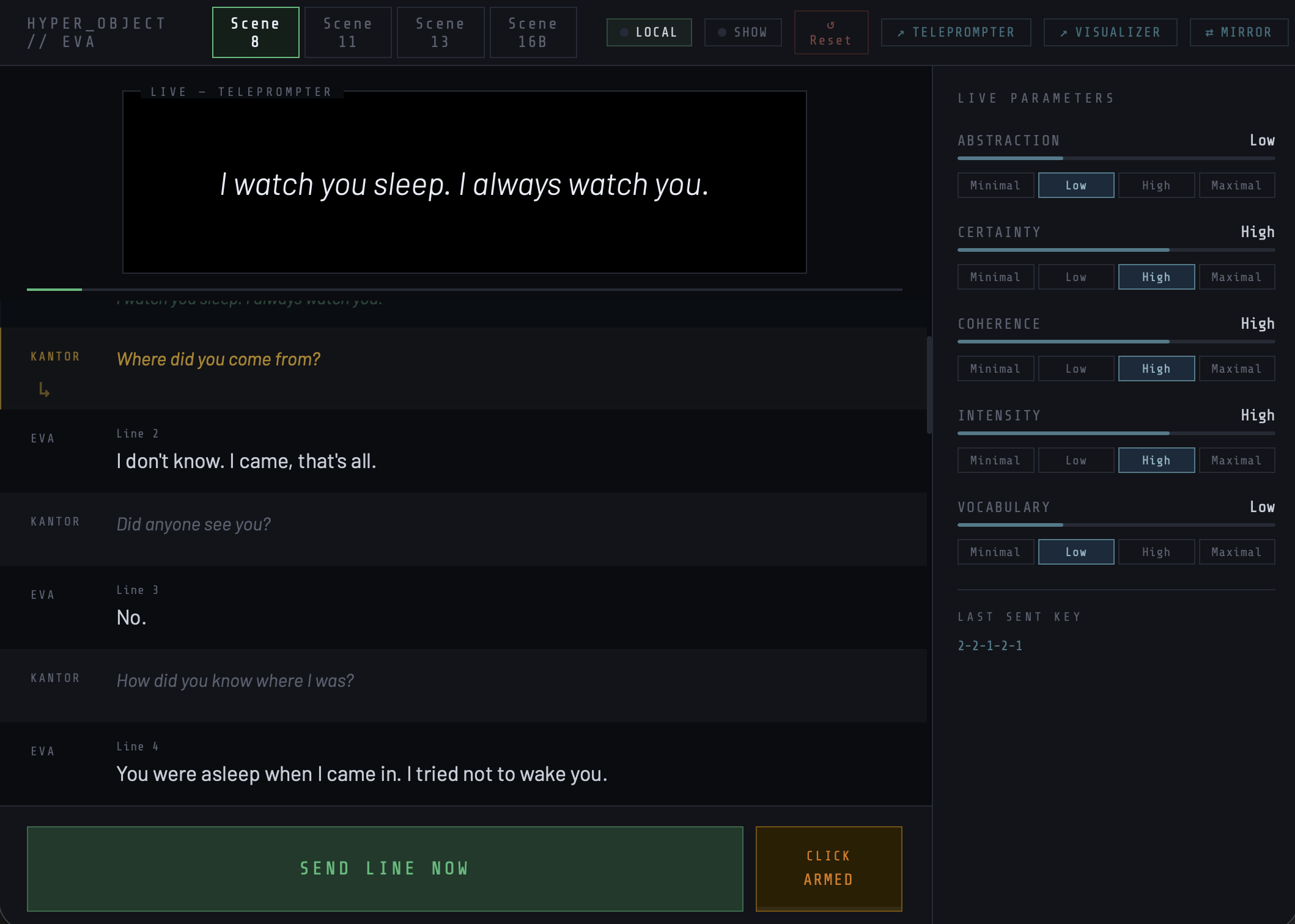
During three key scenes, the actor playing Kantor wore a 32-channel EEG headset. Five live EEG measurements were mapped to the five linguistic parameters. Each parameter could register at one of four levels, producing 1,024 possible combinations for every system-driven line.
Rather than make live API calls during the performance, I used the Anthropic API in advance to generate the complete range of dialogue variants. During the show, the EEG did not generate new text. It determined which pre-generated line the system retrieved.
That decision eliminated live-model latency while preserving a real-time relationship between Kantor’s changing brain activity and Eva’s dialogue. The selected line was routed to the actress’s teleprompter and simultaneously displayed as part of the stage projection.
Designing for live performance
A technically successful prototype is not automatically a usable performance system. The interface had to function under rehearsal and show conditions, where operators were managing multiple responsibilities and performers could not wait for software. I reduced the system to essential actions, streamlined the line sequence, maintained a visible history, and designed the interface around fast, reliable delivery.
The eva_rewriter also appeared only in scenes where it served the dramatic arc. As Eva begins to gain independence from Kantor, the system falls away. The technology was designed to support the story rather than become a constant effect.
50+ collaborators across six disciplines
The production brought together collaborators from medicine, engineering, bioethics, theater, film, and research to explore the relationship between storytelling, AI, and wearable neurotechnology.
The production later received a Johns Hopkins Sesquicentennial Arts Award.
Equipment
coordination
Supported equipment coordination and facilities management during the workshop and production period.
Camera
operation
Operated a live-feed Sony FS7 camera on stage as part of the performance.
Cross-disciplinary collaboration
Worked across disciplines to make the system understandable and usable for production collaborators.
Live performance testing
Tested and refined the system under rehearsal and show conditions to support fast, reliable dialogue delivery.
What the project demonstrated
The eva_rewriter demonstrated that literary interpretation could become the operational logic of a live technical system. The project worked because the engineering was grounded in the character’s dramatic and textual history. The result brought one of storytelling’s oldest questions to the stage: What does it mean to speak in a voice that may not be your own?
Attendees at the premiere
Dialogue combinations for every system-driven line
EEG channels on the headset
Solaris adaptations analyzed
Next project: NeuroCinema
See how a brain-computer interface prototype influenced film editing in real time